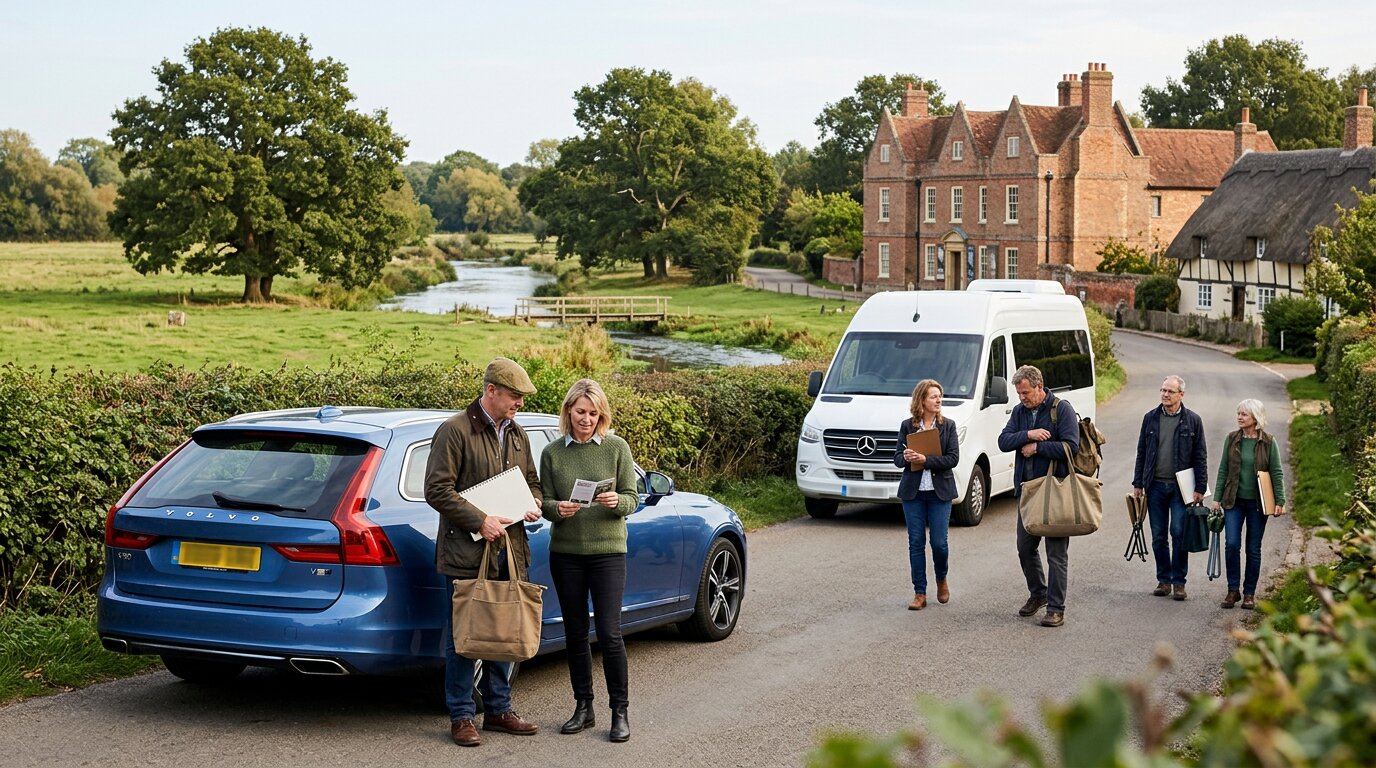
Constable Country sits on the Essex–Suffolk border, and within a short drive you can see where Constable painted, the home and studio of Sir Alfred Munnings, and the birthplace of Thomas Gainsborough. A couple can do two of those comfortably in a day by car. A group needs more planning, mostly around parking, booking and who drives.
Below are two planning paths, one for each. Both start with the same step: check what’s actually open on your date.
Step one: check the venues, not just the map
Opening patterns here are seasonal and sometimes surprising, so look them up for your exact day. Two examples:
- The Munnings Art Museum in Dedham opens seasonally, roughly spring to autumn, on selected days and for an afternoon session rather than all day. Check the dates and hours for the year you’re visiting on its website. The museum also takes group bookings, including outside its usual hours.
- Gainsborough’s House in Sudbury generally opens daily, but its exhibition galleries close for a few weeks between shows while they’re changed over, even though parts of the house stay accessible. Check the current programme on the museum’s website if there’s a particular exhibition you want to see.
Flatford, where Constable painted some of his best-known scenes, is looked after by the National Trust. Check the Trust’s own page for parking and facilities before you set off, rather than relying on older guides.
Path one: a couple, one car, one day
For two people, a car gives the most freedom. You can stop at a village, change your mind about lunch and leave when you’ve had enough.
A sensible shape for the day
- Morning: Gainsborough’s House, which opens in the morning (10am at the time of writing). The museum’s getting-here page doesn’t mention on-site parking, but it lists three public car parks a short walk away, including North Street (199 short-stay spaces). Kingfisher Leisure Centre and Sudbury station offer all-day pay and display.
- Afternoon: Dedham and Flatford. If the Munnings museum is open on your date, an afternoon session there fits neatly after lunch in the village.
- Leave room for walking. The Flatford and Dedham area is best seen on foot, and the paths between them are part of the point.
If you don’t have a car
Plenty of couples come by train to Colchester or Manningtree and want a car for the day. Witham, in mid-Essex, is one possible starting point: carhirewitham.co.uk lists cars from compact models to estates and automatics. Confirm the pick-up arrangement, the insurance excess and whether a second driver can be added before you book, and check the return time against the last train you want.
Path two: a pre-organised group
An art society, a U3A group or a painting class changes the maths. Parking several cars near a small village museum is hard, and keeping a group together across two venues is harder. A minibus solves both problems if someone in the group can legally drive one.
Licences first
A standard category B licence covers vehicles with up to 8 passenger seats. Larger minibuses need category D1, which covers up to 16 passenger seats (GOV.UK). GOV.UK’s guidance on driving a minibus explains when a car-licence holder can drive a bigger one. Every condition has to be met: the driver is 21 or over and has held their licence for at least two years, drives voluntarily for social purposes on behalf of a non-commercial body, nobody pays for the trip either directly or on the passengers’ behalf, there’s no trailer, and the minibus is within the weight limit (3,500kg maximum authorised mass, or 4,250kg for an electric or hydrogen vehicle). Drivers aged 70 or over also need to meet the Group 2 medical standards. If your group can’t meet all of that, don’t assume a car licence is enough: the driver may need D1 entitlement, and if passengers are paying, how the trip is run may need a permit or operator’s licence as well. A permit doesn’t replace the driver’s own licence requirements, so check both questions separately. Check your licence entitlement and the hirer’s terms before you book.
Book the venues as a group
- Gainsborough’s House offers a group rate for 10 or more and recommends allowing at least three hours. Its group visits page asks you to confirm a date with front-of-house staff before completing the booking form.
- The museum names a coach drop-off point on Gainsborough Street and coach parking at the Kingfisher Leisure Centre. Ask whether the same arrangements apply to a minibus.
- For the Munnings museum, use its group booking form and ask about parking for your vehicle size, as the website doesn’t set this out.
Coming from further away
Not every group lives nearby. A Lincolnshire art club starting from Boston, for example, faces a long drive each way, so plan for at least two drivers and proper breaks. Some groups make it an overnight trip. For a group starting there, Boston minibus hire options range from seven to 17 seats. Ask for the passenger seat count and plated weight of the exact vehicle, and check them against the GOV.UK conditions above rather than relying on a general description of the vehicle. Minibus licensing is where group trips most often come unstuck.
Car or minibus: comparing the return journey
| Couple by car | Group by minibus | |
|---|---|---|
| Finishing time | Flexible; leave when you like | Set in advance so the driver’s day stays reasonable |
| Parking | Public car parks near each venue | Ask each venue; coach/minibus space can be limited |
| Drivers | One is fine; two is better for a long day | At least two named drivers with the right licence |
| Returning the vehicle | Check the return time against the last train if you came by rail | Agree who returns it, refuels it and checks for left-behind sketchbooks |
The views that drew Constable are still there. Opening times, booking rules and parking arrangements change every season. Check those three things for your date and the rest of the day tends to take care of itself.

